Facial Trauma · Volume III of 6
Rebuilding the Midface
Restore midface dimensions by selecting trustworthy references, rebuilding the maxillary platform and buttresses, and verifying nasal, canthal, malar, orbital, and occlusal relationships together.
Orientation
About this volume
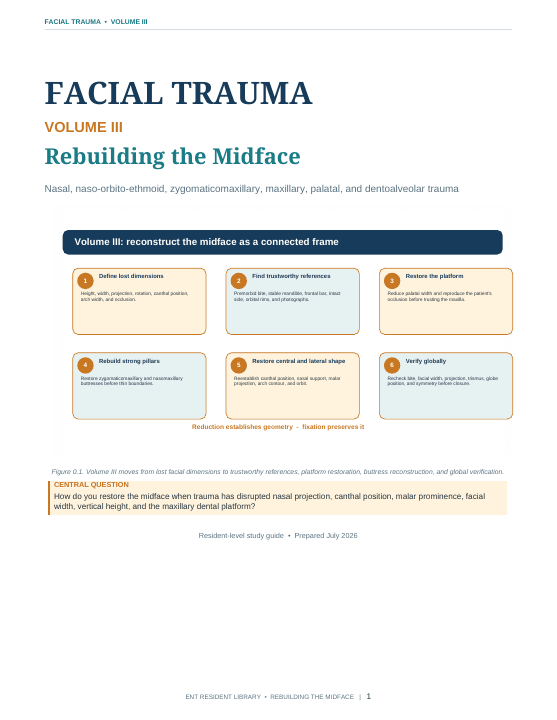
Volume III turns the injury map into region-specific reconstruction of the central and lateral midface. It treats nasal, NOE, zygomaticomaxillary, Le Fort-level, palatal, and dentoalveolar injuries as a connected three-dimensional frame rather than isolated fracture labels. Residents learn to define lost height, width, projection, rotation, canthal position, arch width, and occlusion; identify references that remain trustworthy; restore the dental platform; and verify the whole face before closure. Chapters on exposure, reduction, fixation, postoperative assessment, and secondary deformity make the reconstructive logic practical. It follows Volume II’s upper-face emergencies and uses the mandible and orbit as references, while leaving mandibular biomechanics and condylar management to Volume IV.
After completing this volume, the resident should be able to
- Define midface injury by lost dimensions, occlusion, orbital support, and central or lateral structural relationships.
- Select reliable references and sequence reduction before definitive fixation of the maxillary platform and buttresses.
- Recognize early and late failure through occlusion, canthal position, width, projection, globe position, and trismus.
Reader
PDF preview
Preview before loading
The full PDF is loaded only when requested to keep this page fast, especially on mobile.