Facial Trauma · Volume IV of 6
Restoring the Mandible
Use occlusion, ring biomechanics, fracture pattern, condylar function, and independent verification to plan mandibular stabilization, rehabilitation, and complication surveillance.
Orientation
About this volume
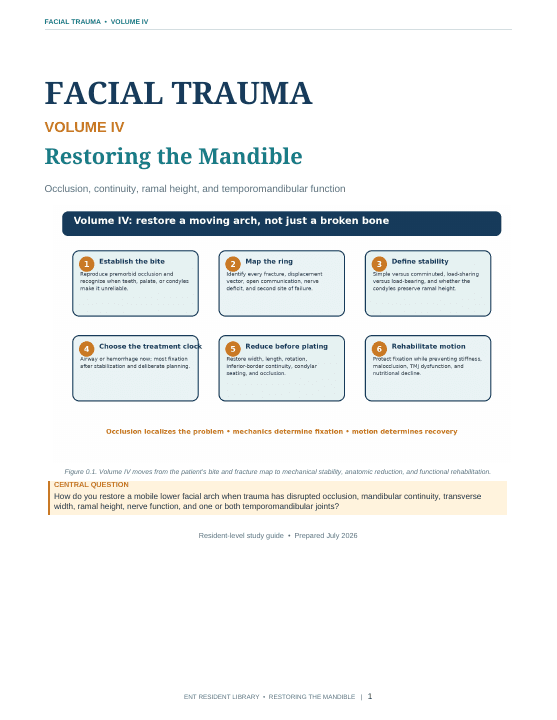
Volume IV focuses on the mobile lower facial arch: occlusion, mandibular continuity, transverse width, ramal height, nerve function, and temporomandibular mechanics. It begins with examination, CT, treatment timing, teeth, and biomechanics, then applies load-sharing and load-bearing logic to anterior, body, angle, ramus, and condylar fractures. Residents learn to choose between closed functional treatment and ORIF according to fracture level, function, reducibility, rehabilitation capacity, and patient factors rather than a single threshold. Operative exposures, MMF safety, postoperative recovery, and failure analysis round out the workflow. Positioned after the midface volume, this guide uses the dental relationship as a reconstructive reference; complex soft-tissue injury and panfacial sequencing follow in Volumes V and VI.
After completing this volume, the resident should be able to
- Use occlusion, motion, palpation, and CT to localize mandibular injury and identify additional fracture sites.
- Explain how loading, fracture pattern, and reduction quality guide fixation and MMF decisions.
- Compare closed functional treatment and ORIF for condylar injuries while planning rehabilitation and surveillance.
Reader
PDF preview
Preview before loading
The full PDF is loaded only when requested to keep this page fast, especially on mobile.